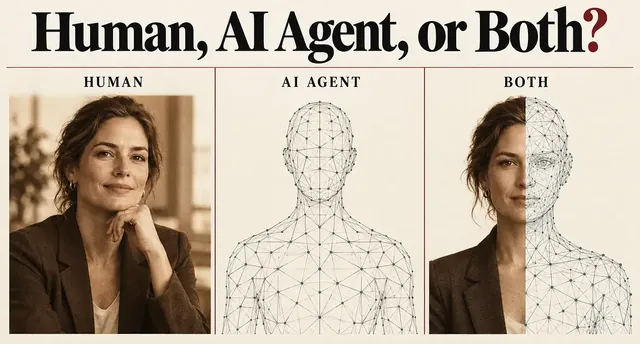
Everything before the first reply went to AI. The reply didn't.
A Montevideo founder, a Denver operations executive and a Melbourne co-founder on where AI outreach stops and a person takes the keyboard.


An agent answered a podcast host's scheduling email in a Denver executive's name. He was already talking to the host.
A Montevideo founder's script replied to leads on its own. It gave the warmest ones the least attention.
In Melbourne, AI carries the volume: about 145 pitches last week.
Same job, three different lines.
We asked: which parts of a job has AI actually taken, and which still need a person? For outreach, the answers all circle one moment: the reply. Three leaders in three countries, one practical puzzle: who gets to speak when a prospect finally answers?
AI does the volume. She does the voice.
Carmen Williams, Co-founder of Global Teams (Melbourne, Australia)
“AI does the volume, my team does the judgement, and I do what only I can: my voice and my stories.”
“Last week that was about 145 pitches.”
The machine gets the count. The part that sounds like her stays with her. Volume is a job for software; voice is not.
The script handled replies. It ignored the warmest ones.
Nico Moreno, Founder of Mentiohunt (Montevideo, Uruguay)
“We once had a job that read new replies from leads, classified them and responded on its own. It saved time, but a reply is the moment someone shows interest, and the script gave the warmest conversations the least attention.”
“Mentiohunt runs outreach automatically up to a prospect's first reply, then stops, and the customer continues the conversation personally from their own inbox.”
His fix was a hard stop, not a smarter script. The automation still runs; it just knows where its turn ends.
The agent answered for him. He was already talking to the host.
Jack Wright, Senior Vice President of Operations, HealthWright Technologies (Denver, United States)
“our press outreach agent once answered a podcast host's scheduling email in my name while I was already talking to him. Now, on any conversation I have touched myself, the agent writes a draft and waits for me.”
“What decides it: whether the step can be undone. Drafting, research and screening go to an agent. Signing, paying and anything that cannot be pulled back stays with a person.”
The agent stays. Its permission to speak got smaller. Note the trigger: a conversation he had already touched himself.
Where they split
Melbourne: AI takes the volume, people take judgement, and the founder keeps her own voice and stories.
Montevideo: automate everything up to the first reply, then stop and hand the conversation to the customer.
Denver: the test is whether a step can be undone. Drafts go to agents. Signing and paying stay human.
The overlap: nobody handed the relationship to the agent. The disagreement is only where the handoff sits.
The surprise: the failures were not about bad drafts. They were about an agent speaking at the wrong moment.
My take
Before you choose human or agent, find your own first-reply moment and draw the line there. Then ask what it costs if the agent gets that moment slightly wrong. If the answer is a lost relationship, keep a person on it.
Your turn
Where does the handoff sit in your outreach: before the first reply, before the send, or somewhere else? Tell us what you learned, and tell us what it cost.
Next: a UK agency that fully automated design and went back to human-led work, a US CMO whose over-automated creative review delayed a launch, and an Italian AI video founder who says customers still want a person on the final cut.